Overview
What it is, how it differs from Bouncer, the indexing → queue → PR flow
Bouncer Plus scans your existing codebase to find and fix legacy accessibility issues—the ones already in production that may have been flagged in prior audits but never remediated.
While Bouncer catches issues in new code (PR-level), Bouncer Plus works backwards through your entire repository, reviewing old files and creating pull requests with suggested fixes.
How It Works
-
Indexing: Bouncer Plus scans your repository and identifies all front-end relevant files (TypeScript, JavaScript, JSX, TSX). It automatically filters out localization files, configuration files, and non-UI code.
-
Review Queue: A prioritized list of files is created. Bouncer Plus reviews them one at a time.
-
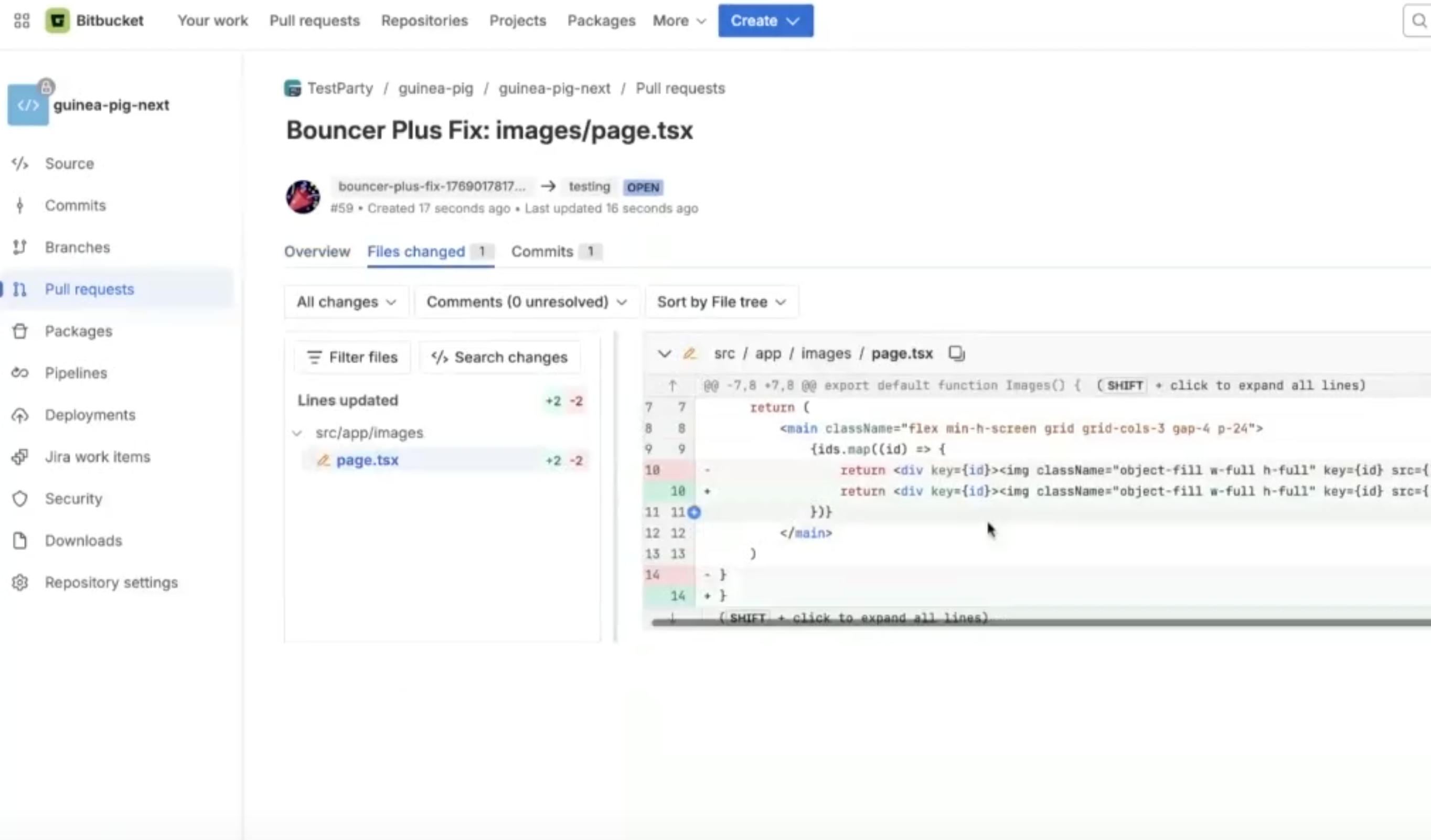
Pull Request Creation: For each file, Bouncer Plus opens a PR with accessibility fixes—tagging your specified reviewers and targeting your chosen branch.
-
Sequential Processing: After your team approves or declines a PR, Bouncer Plus moves to the next file. There's no obligation to process all files at once.
What Gets Fixed
Bouncer Plus uses AI to detect and suggest fixes for:
-
Missing or incorrect ARIA labels and attributes
-
Keyboard navigation issues
-
Color contrast problems
-
Form accessibility gaps
-
Image alt text
-
Focus management
-
Semantic HTML improvements
-
UX and navigation patterns
Changes range from single-line fixes (e.g., adding an alt attribute) to larger refactors (50–100 lines) for complex accessibility patterns.
Bouncer vs Bouncer Plus
|
Bouncer |
Bouncer Plus |
|
|---|---|---|
|
Scope |
New code in PRs |
Existing code in repository |
|
Trigger |
Automatic on every commit |
Manual or automatic queue |
|
Output |
Comments on existing PRs |
Creates new PRs |
|
Goal |
Prevent new issues |
Remediate legacy issues |
Use both together: Bouncer prevents new accessibility debt while Bouncer Plus pays down existing debt.
Technical Details
Infrastructure
|
Component |
Details |
|---|---|
|
Hosting |
AWS (serverless) |
|
Authentication |
GitHub App native authentication (short-lived tokens managed by GitHub) |
|
Region |
Configurable based on enterprise requirements |
|
IP Allowlisting |
Stable IP available via NAT gateway if required |
GitHub Integration
-
Webhook-based: No GitHub Actions or runners required.
-
No CI checks: Bouncer Plus operates via webhooks only—no impact on your CI/CD pipeline.
-
Enterprise compatible: Works with GitHub Enterprise Cloud.
Permissions Required
The Bouncer GitHub App requires:
-
Read access to repository contents
-
Write access to pull requests
-
Write access to commit code (for creating PRs)
Security & Compliance
-
SOC 2 compliant: TestParty has completed SOC 2 audits.
-
AI governance: TestParty tools have passed AI governance reviews at enterprise organizations.
-
No code storage: Code is analyzed in-memory; no persistent storage of your source code.
-
GitHub-native auth: Uses GitHub's built-in app authentication (short-lived, per-session tokens).
For enterprise security reviews, contact your TestParty representative for documentation packages.
FAQ
How long does indexing take?
Initial indexing typically completes within minutes, depending on repository size. Large monorepos may take longer.
Can I prioritize specific files?
Not currently. Files are processed in the order determined by the indexing algorithm. Contact support if you need custom prioritization.
What if I decline a PR?
Bouncer Plus moves to the next file. Declined files may be re-queued in future scans if the underlying issues remain.
Does Bouncer Plus replace manual remediation?
No. Bouncer Plus accelerates remediation by providing suggested fixes, but human review is always required. Your team makes the final decision on every change.
Can I use Bouncer Plus without Bouncer?
Yes, but we recommend using both together—Bouncer catches new issues while Bouncer Plus addresses legacy code.
Next: Setup